

Switchgear distributes, switches, and protects electrical energy in industrial facilities, power plants, and infrastructure projects. The type of switchgear suitable for a particular site primarily depends on the voltage level: low-voltage switchgear operates at up to 1,000 V, medium-voltage switchgear between 1 kV and 36 kV, and high-voltage switchgear from 52 kV upwards.
This article explains the differences between the three voltage levels, describes typical designs and standards, and shows which switchgear class is suitable for each industrial application.
Overview of the three voltage levels
The classification by voltage level follows IEC 60038 and is binding within European electrical engineering. Each level has its own standards, designs, and applications:
| Feature | Low voltage (LV) | Medium voltage (MV) | High voltage (HV) |
| Voltage range | Up to 1,000 V AC / 1,500 V DC | 1 kV to 36 kV | 52 kV to 1,200 kV |
| Typical system voltages | 400 V three-phase, 230 V | 6 kV, 10 kV, 20 kV, 30 kV | 110 kV, 220 kV, 380 kV |
| Main standard | IEC 61439 | IEC 62271-200 | IEC 62271-100 / -200 |
| Typical degree of protection | IP20–IP65 | IP3X–IP5X | Outdoor or SF₆-enclosed |
| Rated current, typically | Up to 6,300 A | 630 A to 4,000 A | Up to 5,000 A and above |
| Short-circuit withstand | Up to 100 kA according to IEC 61439 | Up to 50 kA according to IEC 62271-200 | Up to 63 kA and above |
| Installation location | Buildings, switchgear rooms | Transformer substations, grid connection substations | Substations, outdoor installations |
| Maintenance requirements | Low to medium | Medium | High, requiring specialised personnel |
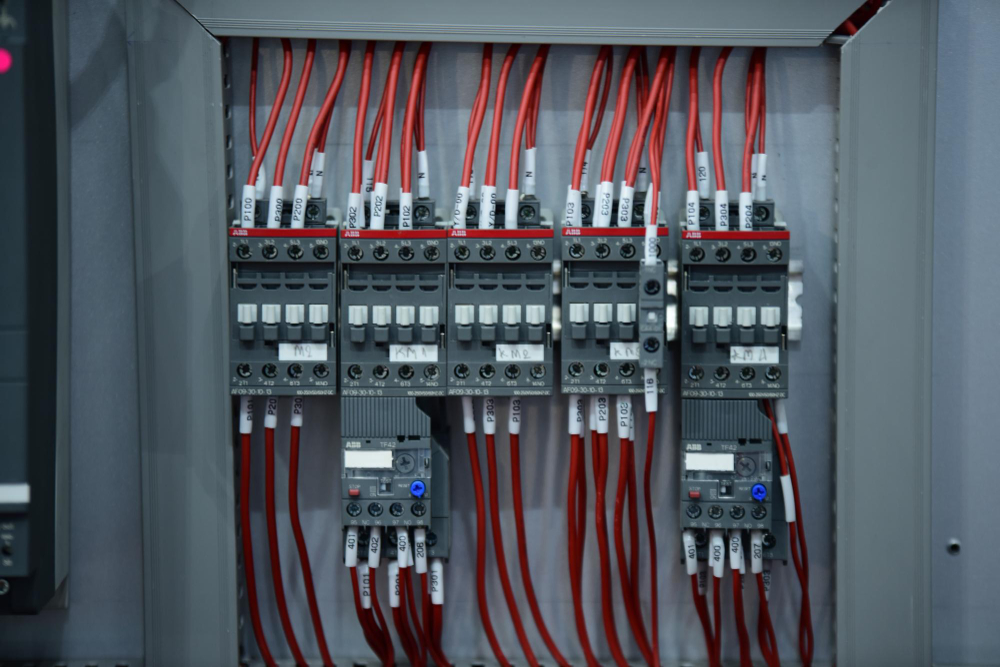
Low-voltage switchgear
Low-voltage switchgear operates at up to 1,000 V AC and is the most commonly used switchgear class in industry. It handles the final distribution of electrical energy to machinery, drives, lighting systems, and auxiliary services.
Typical applications
- Main and sub-distribution boards in production facilities
- Motor controls and starters for pumps, compressors, and conveyor systems
- Auxiliary power supply in power plants and substations
- Power supply for office, commercial, and industrial buildings
Designs
Low-voltage switchgear is constructed as open or enclosed systems installed in switchgear cabinets. Common designs include fixed-mounted switchgear and withdrawable switchgear, in which individual outgoing feeders can be replaced without interrupting the busbar supply. The applicable standard is IEC 61439.
SKS Elektroanlagenbau manufactures low-voltage switchgear for new industrial installations and retrofit projects. The systems are designed for rated currents of up to 6,300 A and short-circuit withstand ratings of up to 100 kA. Every system undergoes comprehensive testing at the company’s own testing facility in Fohnsdorf.
Medium-voltage switchgear
Medium-voltage switchgear forms the interface between the public power grid and industrial power distribution. It handles the transfer of electricity from the grid operator, supplies transformers, and directly feeds large motors at medium-voltage level.
Voltage levels used in industry
In Austria and Germany, 10 kV and 20 kV are the most common industrial medium-voltage system voltages. Older steelworks and chemical-industry networks often operate at 6 kV, while railway power supplies and large regional networks use 30 kV or 36 kV.
Designs
Medium-voltage switchgear is primarily classified according to its insulating medium:
| Design | Features and applications |
| Air-insulated switchgear (AIS) | Proven technology, easy to maintain, and readily accessible. Requires more space. Commonly used at industrial sites, power plants, and EPC projects. |
| Gas-insulated switchgear (GIS) / solid-insulated switchgear (SIS) | Very compact and suitable for confined spaces. SF₆ was permitted until 31 December 2025; from 2026, only SF₆-free technologies are permitted for new systems rated up to 24 kV under EU Regulation 2024/573. SF₆-free systems are robust in environments with high humidity and contamination and are increasingly used in tunnels, offshore facilities, and industrial plants operating under harsh conditions. |
Standards
The main standard for metal-enclosed medium-voltage switchgear is IEC 62271-200, implemented in Austria as ÖNORM EN 62271-200. Circuit breakers are tested separately in accordance with IEC 62271-100. The prescribed type tests include strict testing of short-circuit withstand, temperature rise, and internal arc resistance under the IAC classification.
High-voltage switchgear
High-voltage switchgear operates from 52 kV upwards and is used exclusively in substations and transmission networks. It is generally not part of conventional industrial auxiliary power systems but falls within the responsibility of transmission system operators.
For large industrial facilities, high voltage usually serves only as the incoming voltage supplied by the grid operator. The facility’s own electrical system begins with the medium-voltage switchgear in the grid connection substation, directly downstream of the transformer that reduces the voltage from high voltage to medium voltage.
Which switchgear is suitable for which application?
The choice primarily depends on the assigned grid connection point and the installed capacity of the site. The following practical guidelines apply to industrial projects:
| Site profile | Recommended switchgear |
| Small to medium-sized production facilities and commercial sites below 630 kVA | Low-voltage switchgear supplied directly from the transformer |
| Medium-sized industrial facilities above 630 kVA and up to approximately 10 MVA | Medium-voltage switchgear with a dedicated transformer and grid connection at 10 kV or 20 kV |
| Large industrial sites, steelworks, and chemical plants above 10 MVA | Medium-voltage switchgear with multiple incoming feeders and busbar coupling; in some cases, a direct high-voltage connection |
| Power plants, including hydroelectric, gas, and steam turbine plants | Medium-voltage switchgear for auxiliary power and high-voltage switchgear for grid connection |
| Renewable energy facilities, wind farms, and solar parks | Medium-voltage switchgear in the transformer substation; grid connection via high or medium voltage depending on the size of the facility |
Note: retrofit instead of a new installation
Many existing medium- and low-voltage switchgear systems used in industry are already 20 to 30 years old, making the procurement of spare parts increasingly difficult. A targeted medium-voltage switchgear retrofit—the replacement of circuit breakers and protection relays while retaining the existing enclosure—is often significantly more economical than a complete new installation.
SKS Elektroanlagenbau carries out retrofit projects for medium- and low-voltage switchgear from a wide range of manufacturers, completely independently of any specific manufacturer.
Overview of standards for LV, MV, and HV systems
| Voltage level | Main standard | National implementation in Austria / Germany |
| Low voltage (LV) | IEC 61439 for switchgear assemblies, IEC 60947 for switching devices | DIN VDE 0660, ÖNORM EN 61439 |
| Medium voltage (MV) | IEC 62271-200 for switchgear, IEC 62271-100 for circuit breakers | DIN VDE 0671-200, ÖNORM EN 62271-200 |
| High voltage (HV) | IEC 62271-200, IEC 62271-100 | DIN VDE 0671-200 for higher voltage levels |
Switchgear from SKS Elektroanlagenbau
SKS Elektroanlagenbau plans, manufactures, and services low- and medium-voltage switchgear for industrial customers in Austria and international markets. Before delivery, every system undergoes a complete routine electrical test at the company’s own testing facility in Fohnsdorf.
- Low-voltage switchgear: New low-voltage installations and retrofits designed for rated currents up to 6,300 A and short-circuit withstand ratings up to 100 kA
- Medium-voltage switchgear: New installations and retrofits of air-insulated systems up to 36 kV
- Manufacturer-independent maintenance, servicing, and support for existing systems
- Professional installation and commissioning in Austria and for international EPC projects
Related articles
What is medium-voltage switchgear? – Design, components, and standards explained in detail
Medium-voltage switchgear retrofit – When is modernisation more worthwhile than a new installation?
Standards in switchgear construction: IEC 62271 and DIN VDE