

Medium-voltage switchgear distributes electrical energy within the voltage range of 1 kV to 36 kV.
It is positioned at the interface between the high-voltage network operated by transmission system operators and the low-voltage distribution systems in buildings and industrial facilities.
Without medium-voltage switchgear, safe and selective power distribution in industrial plants, power stations, and infrastructure projects would not be possible.
This article explains how medium-voltage switchgear is constructed, which components it contains, which designs are available, and which standards apply to its planning and operation.
It is written for technicians, plant managers, and procurement professionals who work with medium-voltage systems or make decisions regarding them.
Definition and purpose of medium-voltage switchgear
Medium-voltage switchgear, also referred to as MV switchgear, is an electrical switchgear system that switches, protects, and distributes electrical energy within the range of 1 kV to 36 kV.
It performs three key functions:
- Switching: Controlled switching of circuits on and off during normal operation and in the event of a fault.
- Protection: Detection of overloads, short circuits, and arc faults, followed by isolation of the affected section of the network.
- Distribution: Distribution of electrical energy across multiple outgoing feeders, such as transformers, motors, or busbar systems.
The term “medium voltage” refers to the network level rather than to one specific voltage.
According to IEC 60038, the voltage range from 1 kV to 35 kV is classified as medium voltage in Europe. Industrial medium-voltage networks in Austria and Germany typically operate at 6 kV, 10 kV, 20 kV, or 30 kV.
Voltage levels
| Voltage level | Typical application |
|---|---|
| 6 kV | Industrial auxiliary power supply and older networks in the chemical and mining industries |
| 10 kV | Municipal distribution networks and industrial park power supplies |
| 20 kV | Standard medium-voltage network in Austria and Germany |
| 30 kV / 36 kV | Regional distribution, large industrial sites, and railway power supply |
Design and components
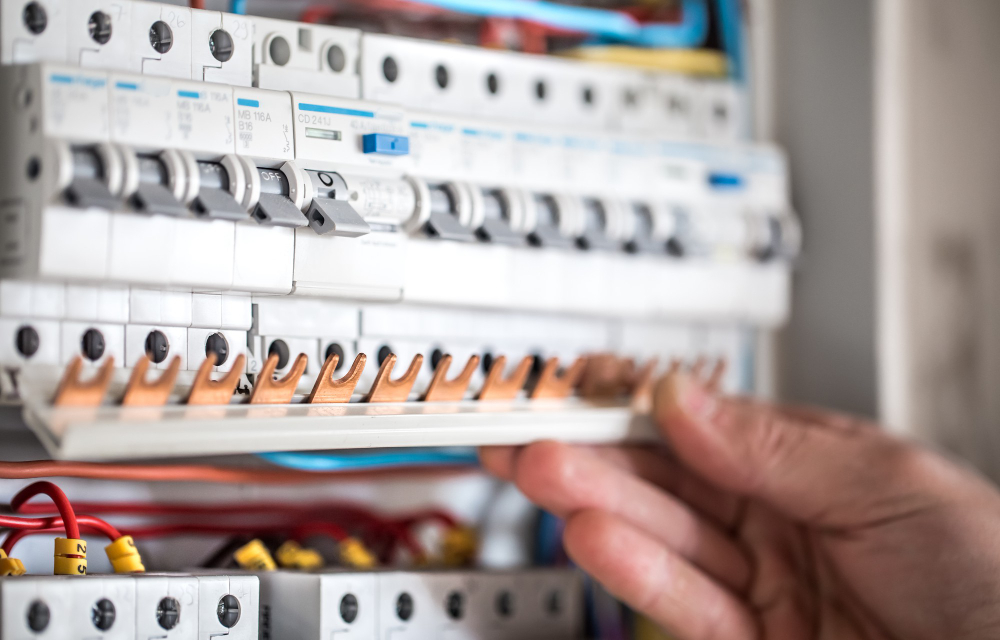
Medium-voltage switchgear consists of several panels arranged in a row.
Each panel performs a specific function, such as incoming supply, outgoing feeder, bus coupler, or metering.
Circuit breakers
The circuit breaker is the central switching device. It interrupts load current during normal operation and short-circuit current in the event of a fault.
Modern medium-voltage switchgear uses vacuum circuit breakers or SF₆ circuit breakers. From 2026, the use of SF₆ in new systems rated up to 24 kV is restricted under EU F-Gas Regulation 2024/573.
Disconnectors and earthing switches
Disconnectors operate under no-load conditions and provide a visible isolation point during maintenance work.
Earthing switches connect the circuit to earth before personnel begin working on the system.
Both are safety components and are not designed to switch load currents.
Protection relays
Protection relays monitor current, voltage, and frequency in real time.
When they detect a fault, they send a trip command to the circuit breaker.
Typical protection functions include:
- Overcurrent protection (ANSI 51)
- Distance protection (ANSI 21)
- Differential protection (ANSI 87)
- Earth-fault protection (ANSI 64)
Current and voltage transformers
Instrument transformers reduce current and voltage to measurable secondary values, typically 5 A and 100 V, for protection relays, meters, and control systems.
Reliable protection is not possible without accurate instrument transformers.
Busbars
Copper or aluminium busbars electrically connect all panels within the switchgear system.
The busbar determines the rated current of the entire switchgear assembly, typically between 630 A and 4,000 A for industrial systems.
Designs: air, gas, and solid insulation
The insulating medium between live parts and earthed components has a major influence on the size, maintenance requirements, and application of medium-voltage switchgear.
Comparison of designs
| Design | Insulating medium | Typical application |
|---|---|---|
| Air-insulated switchgear (AIS) | Air / vacuum | New industrial installations, power plants, and EPC projects |
| Gas-insulated switchgear (GIS) | SF6 or F-gas-free insulation | Compact urban power distribution |
| Solid-insulated switchgear (SIS/SSIS) | Epoxy resin / solid insulation | Damp or contaminated environments |
Note: SF6 ban from 2026
EU Regulation 2024/573, also known as the F-Gas Regulation, prohibits the commissioning of new SF₆-insulated switchgear rated up to 24 kV from 1 January 2026.
- Exceptions apply to extensions and repairs of existing systems.
- SF6-free technologies must be planned for new installations.
- Existing SF6 systems may continue to operate.
- Demand for retrofit solutions is therefore increasing.
Standards and regulations
| Standard | Scope |
|---|---|
| IEC 62271-200 | Main standard for metal-enclosed medium-voltage switchgear up to 52 kV |
| IEC 62271-1 | General requirements for switchgear and controlgear |
| IEC 62271-100 | Alternating-current circuit breakers |
| DIN VDE 0671-200 | German implementation of IEC 62271-200 |
| ÖNORM EN 62271-200 | Austrian implementation |
| IEC 61439 | Corresponding standard for low-voltage switchgear assemblies |
| IEC 60038 | Standard voltages and definition of the medium-voltage range |
Industrial applications
- Steel and aluminium plants
- Hydroelectric, gas, and steam power plants
- Chemical and petrochemical industries
- Infrastructure
- Renewable energy
- EPC projects
Maintenance and service life
Medium-voltage switchgear is designed for a service life of approximately 25 to 40 years.
| Maintenance interval | Measures |
|---|---|
| Annually | Visual inspection, cleaning, and functional testing |
| Every 3–5 years | Protection relay calibration and insulation measurement |
| As required / retrofit | Replacement of outdated components |
Systems that are more than 20 to 25 years old and for which spare parts are no longer available are suitable candidates for a retrofit.
Medium-voltage switchgear from SKS Elektroanlagenbau
SKS Elektroanlagenbau manufactures and services medium-voltage switchgear for industrial customers in Austria and international markets.
- New and replacement air-insulated medium-voltage switchgear
- Retrofit of existing systems
- On-site installation and commissioning
- In-house testing facility in Fohnsdorf
Further information
Medium-voltage switchgear retrofit – When is modernization more worthwhile than a new installation?
Testing facility – High-current testing before delivery
Standards in switchgear construction: IEC 62271 and DIN VDE